On this page
Writing
Would free electricity actually save you money?
Australia is getting three-hour free electricity windows but this is not a guarantee of savings for everyone.
TL;DR
- Very low use — switching won't matter. At ~4 kWh/day like the bill below, the daily supply charge dominates. Even a perfect window saves cents a day.
- Evening-heavy — costs ~$27/month more. Out 7am–6pm, gas hot water/heating, no EV, no timers: the model household uses 10.5 kWh/day, puts ~0.5 kWh in the window, and pays ~$153 vs ~$126 on the flat plan. A window you can't use is worth $0 — but the higher evening rates still bill you.
- Heavy use with the right shape — saves real money. WFH, EV on a timer, electric hot water/heating, pool pump, or dishwasher/dryer on delay: the model household moves ~8.3 of 18.7 kWh/day into the window and saves around $40/month — same tariffs, different household.
So, read more to find out if you'll be able to save on your next electricity bill!
Context in 30 seconds
There's a new change to electricity plans in Australia: you can now opt into a three-hour free electricity window every day. If you're in Victoria, it's called the Midday Power Saver (from 1 October 2026). If you're in New South Wales, South Australia or South-East Queensland, it's the federal government's Solar Sharer Offer (from 1 July 2026). Same idea: use electricity when daytime solar is abundant, and that usage can effectively cost you $0/kWh.
Sounds like a no-brainer, right? Well... maybe. "Three hours free" doesn't mean cheapest bill.
You don't need solar panels — you "share" daytime solar by consuming at the right time.
Why free midday? Rooftop solar floods the grid midday (cheap wholesale) while demand spikes in the evening (cooking, heating/cooling). Retailers want you to shift use to when it's abundant.
| State/region | Free electricity |
|---|---|
| NSW | 11am–2pm |
| South-East Queensland | 11am–2pm |
| South Australia | 12pm–3pm |
| Victoria (from 1 Oct 2026) | 11am–2pm |
Windows are fixed year-round in local time. Victoria needs a smart meter and a retailer with 1,000+ customers. Tasmania isn't included. The tool below defaults to 11am–2pm with a 12pm–3pm switch for South Australia.
Find your numbers on your bill in 2 minutes
Grab your last bill — paper, PDF, or app — and find these three numbers. This is the only definition you need:
- Daily supply charge ($/day) — fixed cost just for being connected. You pay it even if you use nothing.
- Usage rates (c/kWh) — what you pay per unit, especially the evening/peak rate.
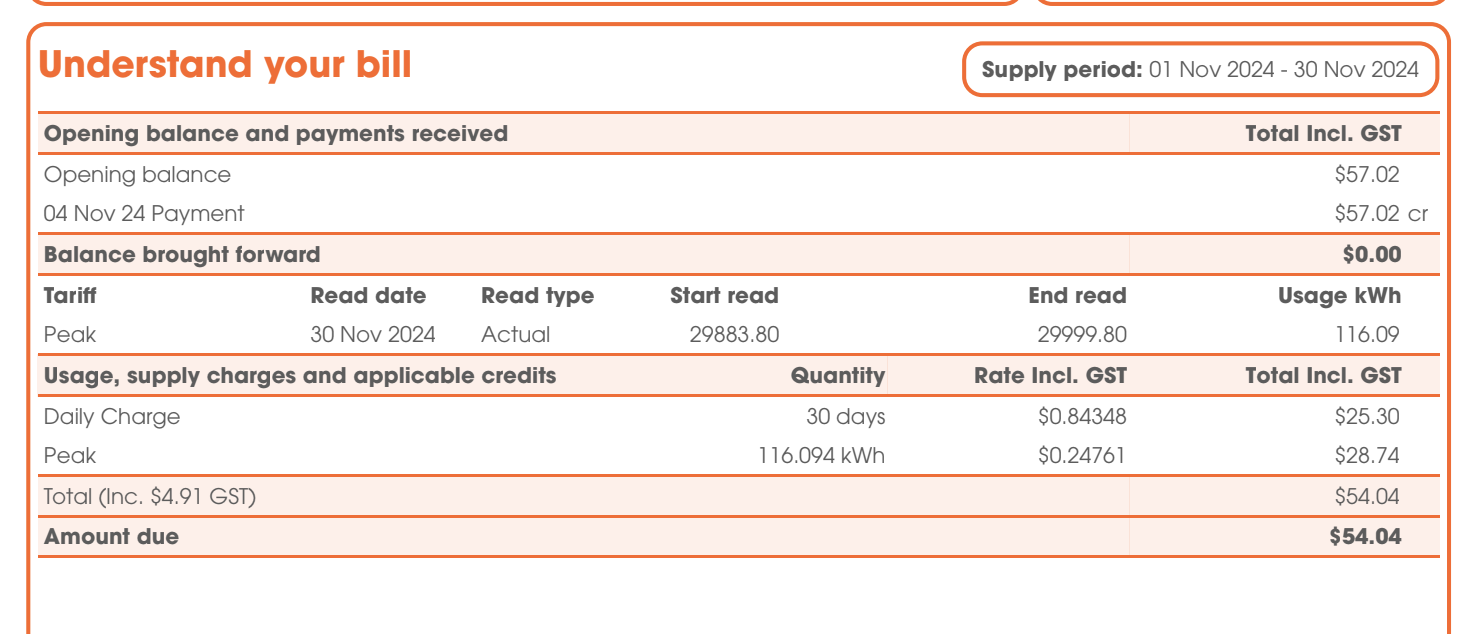
Example bill, Nov 2024 (30 days): Daily Charge $0.84348/day → $25.30, Peak 116.09 kWh @ $0.24761 → $28.74, total $54.04. That's ~3.9 kWh/day — very low use. Circle the same three numbers on your bill.
No bill handy? Use 10–12 kWh/day for a small household, 16–20 kWh/day with an EV or electric heating. Your real bill beats any average.
Free window, full price outside it
The free window only affects usage. The real question isn't "how much free electricity do I get?" — it's "how much will I save versus my current plan?"
Retailers recover the free hours elsewhere. Take the 2026–27 Solar Sharer regulated tariff in NSW's Ausgrid area: supply ~$1.76/day, $0/kWh 11am–2pm, ~27.56c/kWh outside it, ~63.72c/kWh 3pm–9pm peak — versus a standard time-of-use at ~24c off-peak / 60c peak. Free lunch doesn't eliminate expensive dinner.
Back-of-the-envelope: 5 kWh/day shifted at 35c/kWh is 5 × $0.35 × 365 ≈ $640/year potential — before subtracting higher non-free rates and supply differences. Hence the whole-plan comparison below.
Two separate tests: can you use it? Does that plan save you?
- 1. Profile suitability: how much can realistically happen in the window? EV on a timer + dishwasher delay = good shape. Office all day + everything at 7pm = not.
- 2. Tariff economics: given this plan's supply charge and non-free rates, is it cheaper for your profile? Two plans with identical windows can differ enormously.
You can be a great fit for the idea and still lose money on a particular plan.
If you're out all day: the free plan costs ~$27/month more
Tool default: 2 adults, office five days a week. Gas hot water/heating, no EV, no pool, no solar. About 10.5 kWh/day.
Evenings spike; the window holds ~0.5 of 10.5 kWh, with only 2.9 kWh movable. Tariff A (28c flat, $1.20/day supply) comes to ~$126/month; Tariff B (free 11am–2pm, 46c evening peak, $1.25/day) comes to ~$153/month. Difference: +$27/month.
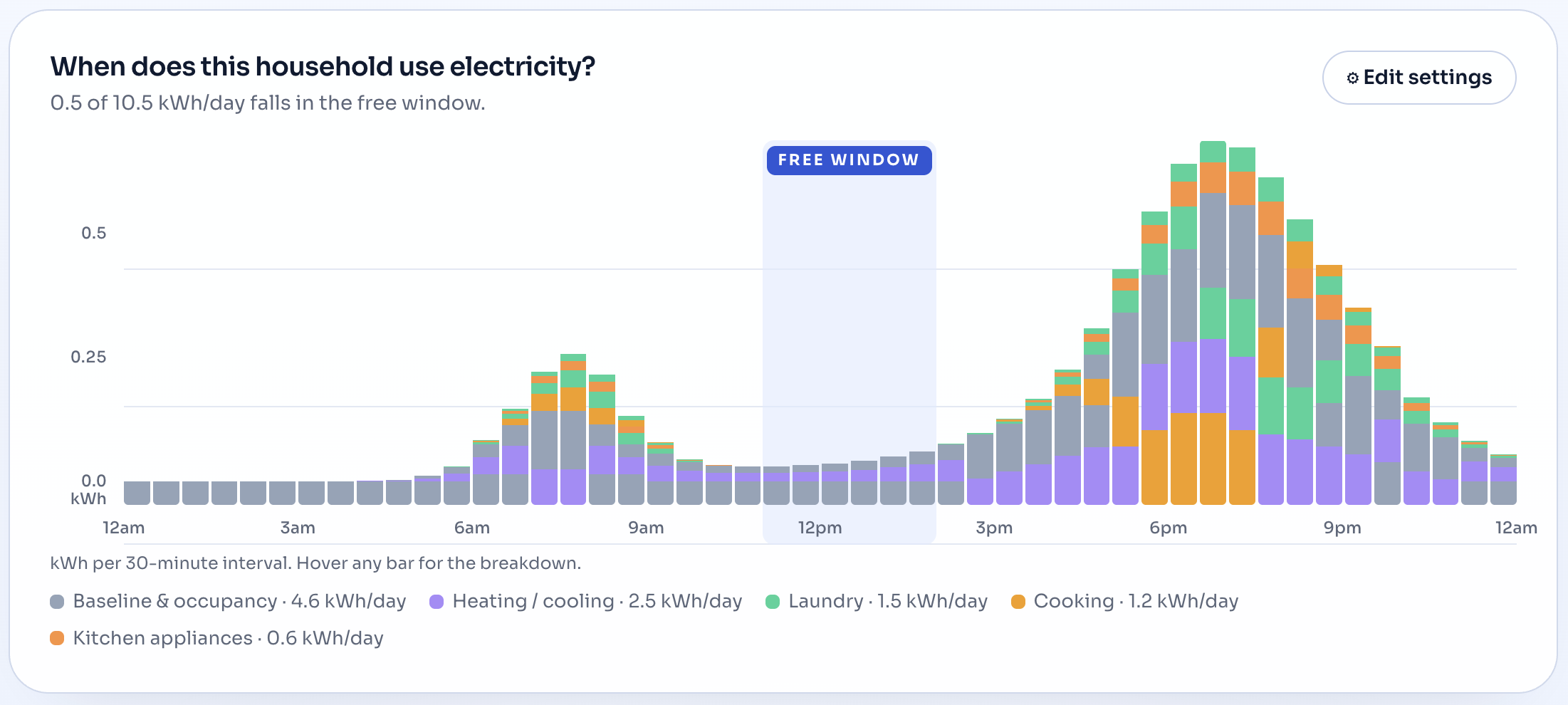
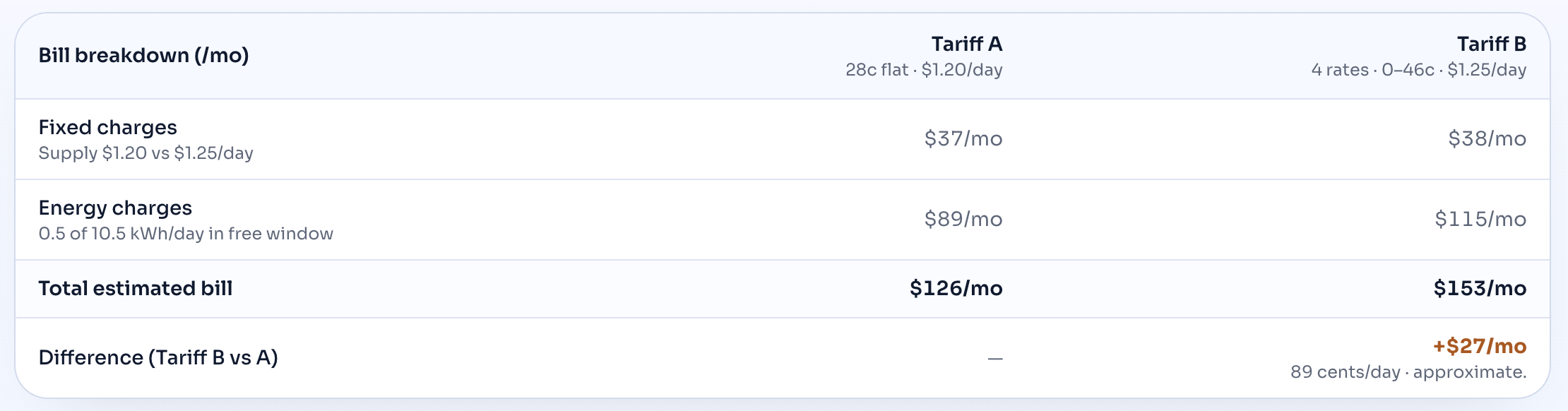
The starting household barely touches the free window — and the free plan costs $27/month more.
The tariff didn't fail this household. The household has nothing to put in the window.
If you WFH + charge your EV at midday: saves ~$40/month
Change two things: work from home three days a week, add an EV (250 km/week) charged inside the window. Prices untouched.
Now ~8.3 of 18.7 kWh lands in the window and the bill drops from ~$196/month to $156. Saving: **$40/month**. Same tariffs, different household.
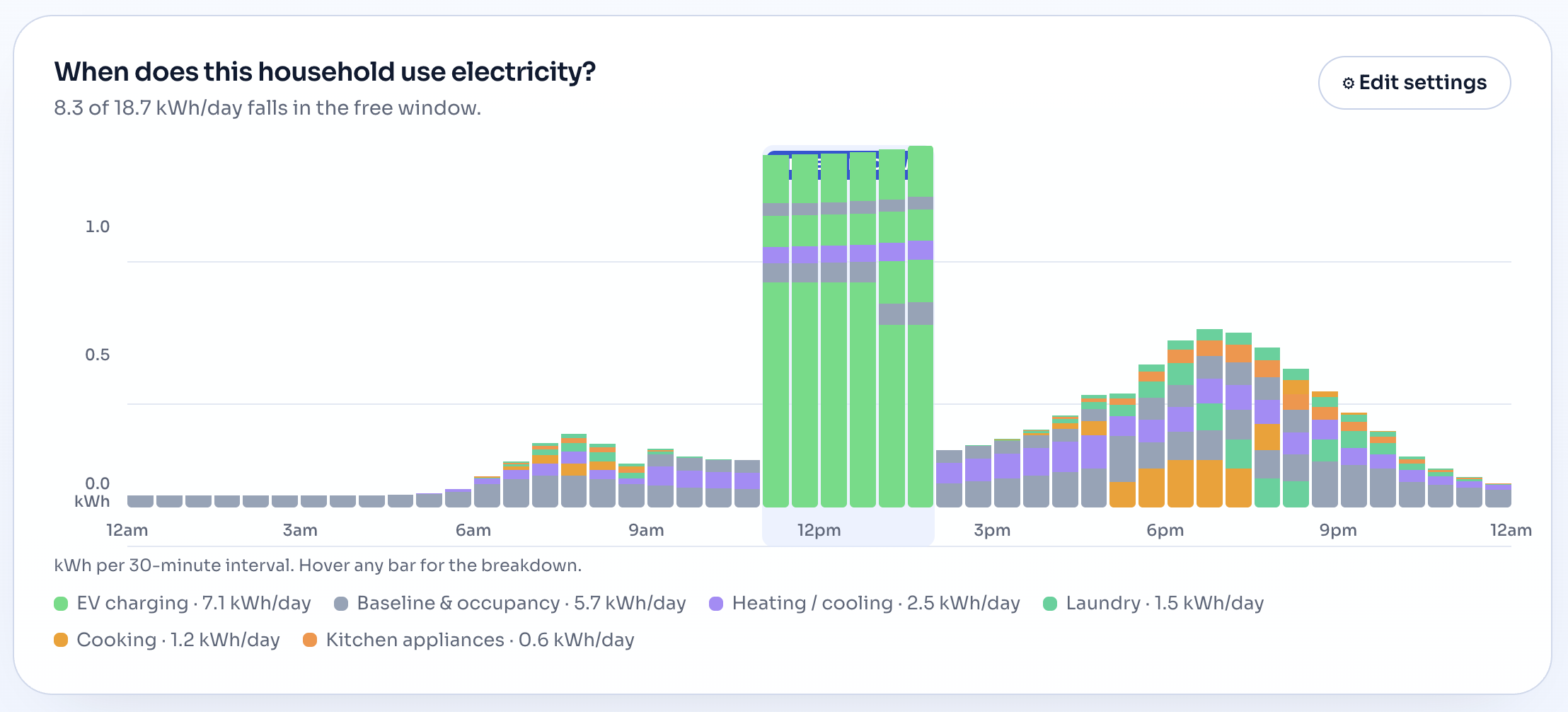
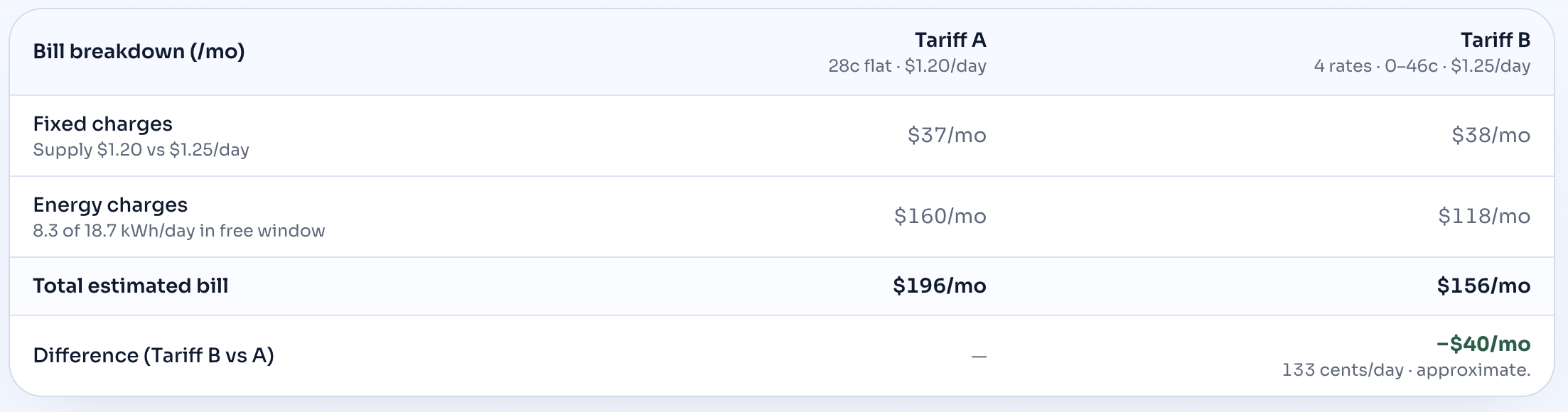
Two changes, same tariffs: 8.3 kWh a day moves into the window, bill falls $40/month.
Your profile matters more than the marketing.
Right habits, wrong plan: why a good fit can still cost +$50/month
Now the twist. Take that high-potential household but charge the EV the way most people do: plugged in after work, in the evening, unshifted. Only 1.2 of 18.7 kWh lands in the window — yet 10 kWh a day could move there. Tariff A comes to ~$196/month; Tariff B (free midday, 46c evening peak, $1.25/day) comes to ~$246/month. Difference: +$50/month.
Tariff B only breaks even once ~41% of flexible use shifts into the window.
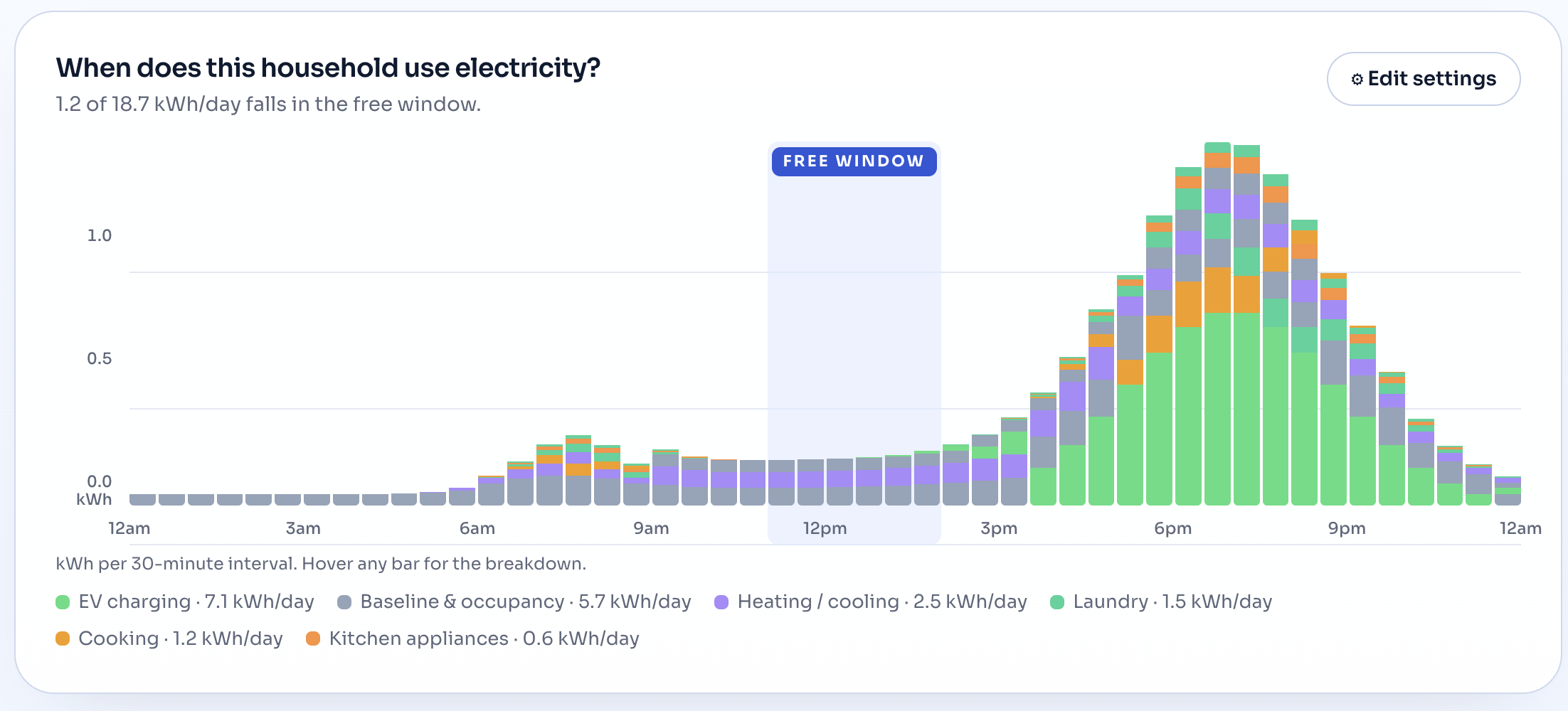
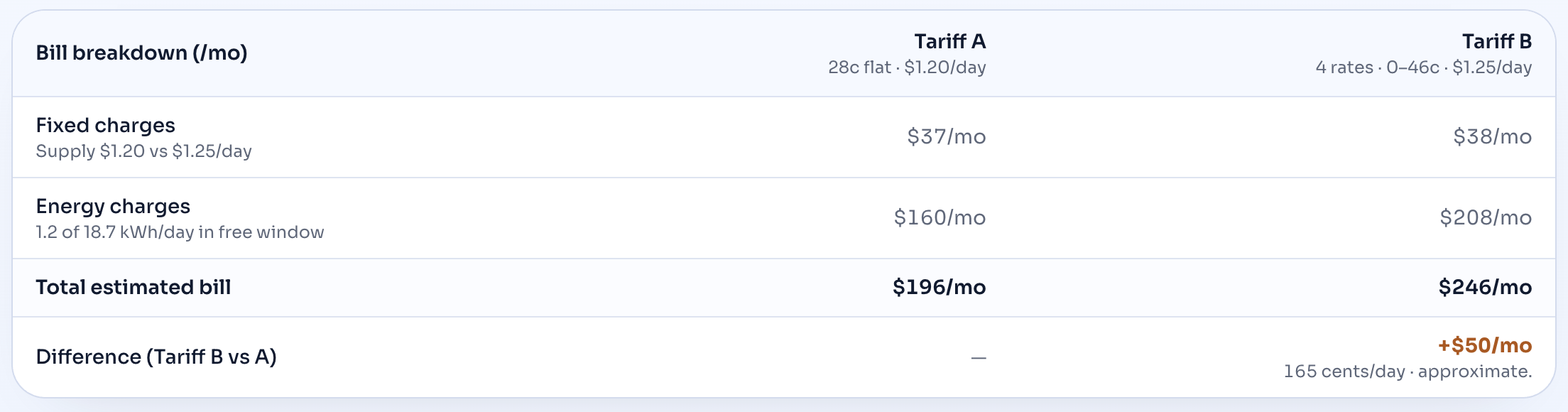
Same high-potential household, EV charged in the evening — the free plan costs $50/month more.
Good fit and good deal are two different tests. Pass both before switching.
Before you switch: check these 4 numbers in order
1. Supply charge difference. $1.00 vs $1.30/day = ~$110/year before you use anything. Matters most for low-use homes.
2. Evening rate. Don't read "FREE!" — read "what do I pay at 7pm?" +5c/kWh on 5 kWh/day outside = ~$91/year to earn back first.
3. When you use power. When is now decisive. Biggest levers: EV ($61/month fully moved), dryer ($9), dishwasher (~$5).
4. Whether you'll actually shift. WFH/retired or EV on a timer: easy. Out 7am–6pm: don't reorganise your life — a good plan fits you. Timers do the work (washer 10:59, dishwasher 11:30, EV noon, dryer 1pm).
Fine print: federal offer caps free use at 24 kWh/day (most homes won't hit it). Compare estimated annual cost for your usage — Victorian Energy Compare in Victoria, Energy Made Easy elsewhere. Ignore "fixed monthly payment" framing; it's cash-flow, not cheaper power. Check robustness too: the WFH+EV household saves ~$40 as-is, ~$60 with realistic shifting, ~$74 at maximum. A plan that only wins at 100% adherence is hoping.
The bottom line: compare the whole tariff, not the headline
When matters as much as how much now. These tariffs reward using power when it's abundant — good for the grid if enough homes shift. But the product is the entire tariff: supply charge, non-free rates, your timing, shiftable load, and caps. Compare that, not the headline.
Now it's over to you: use the tool below to see if you're a good fit for this new energy plan!
Interactive tool
Try your own household
When does this household use electricity?
0.5 of 10.5 kWh/day falls in the free window.
kWh per 30-minute interval. Hover any bar for the breakdown.
What could you move?
Toggle loads into 11am–2pm — the chart and bills update instantly.
Clothes dryer
7.5 kWh/week · Highly flexible
Heating / cooling
5.2 kWh/week · Moderately flexible
Dishwasher
4.4 kWh/week · Highly flexible
Washing machine
3.2 kWh/week · Highly flexible
Compare tariffs
Same household, two bills. Fixed charges apply every day — energy charges depend on when you use power.
| Bill breakdown (/mo) | Tariff A28c flat · $1.20/day | Tariff B4 rates · 0–46c · $1.25/day |
|---|---|---|
| Fixed chargesSupply $1.20 vs $1.25/day | $37/mo | $38/mo |
| Energy charges0.5 of 10.5 kWh/day in free window | $89/mo | $115/mo |
| Total estimated bill | $126/mo | $153/mo |
| Difference (Tariff B vs A) | — | +$27/mo89 cents/day · approximate. |
About these numbers
Simplified illustration, not a bill prediction or personal advice. Monthly cost = (supply charges + half-hourly usage × period rates) × 365 ÷ 12. Excludes solar exports, controlled loads and concessions. Free-window plans are illustrative, not real retailer offers. Same load profile feeds the chart and the cost engine; identical inputs always give identical outputs.